Jennifer Townley
Kinetic Artist
I have always been fascinated by the transformation of motion and power that takes place within a machine and the way all the independent mechanisms form a whole and work together.
A machine can transform a simple circular movement (a rotating motor) into a very complicated non-linear or even chaotic movement. However, no matter how complicated a mechanical machine may seem, its functioning is always predictable and logical because it follows the laws of nature. The machine’s inner workings are revealed when you study its path of transformation and power.
This fascination for mechanical movement, combined with my interest in the way our brain responds to repetitive movements and patterns results in the machines I build. Through my machines I experiment with different ways to emphisize movements or show what patterns are hidden within the movements.
Unlike regular machines mine do not aim to deliver a product. The purpose of the machine is the operation of the machine itself. While watching, eyes and ears get equally caught in the slow movements of the machine and are captivated by its repetitive path which can create an almost hypnotizing effect.
E-mail: mail@jennifertownley.com
Keith Newstead
Automata Artist
I was born in Romford, Essex in 1956 and went to Pettits Lane Secondary school. One of my early childhood memories was of seeing penny slot machines at a nearby seaside town called Southend.
When a penny was inserted a little scene would be automatically played out and I was fascinated as to how these machines worked. At the time I did not know that they were called automata (a machine that imitates life)
Later I went to Essex University and gained a degree in Graphic art . I worked in an art studio for a while and then spent time travelling, at one point I was a postman in Finland, and finally ended up as a motorcycle despatch rider in London, a job which lasted for ten years.
Towards the end of my despatch riding career I saw a TV program about the late Sam Smith, an automata maker. My early fascination with these machines flooded back to me and I immediately started to make my own. It wasn’t long before I was successfully selling my work at a shop in London called Cabaret Mechanical Theatre and after a short period I was making a full time living and could give up despatch riding.
The thing I love about automata is the way it brings enjoyment and entertainment to both young and old alike. I work in different materials, sometimes new and sometimes re-cycled, and different styles but it’s the movement that makes the connection with my audience. So I see myself as much as an entertainer as an artist.
I have exhibited all over the world , one of my favourite commissions being a collaborative work with the cartoonist Ralph Steadman.
I also make automated donation boxes for museums and art Gallery’s and have work in The Natural History museum and The Eden Project in the UK.
I have also produced card automata kits, and at one outlet, the Tower of London, I have sold over one million.
I live in a small village called Penryn in Cornwall and work at home. In the future I would like to get into the film world. Now that computer generated effects are so perfect I feel it’s a good time to go back to something more basic, like the machines made by my hero Rowland Emmitt for the film Chitty Chitty Bang Bang.
E-mail: keith@keithnewsteadautomata.com
Willi Reiche
Kinetic Artist
Willi Reiche (born in Germany in 1954) studied History of Art in Bonn. He embarked on his career in 1982 by exhibiting his works of art at numerous individual and collective expositions. In 1990 he gave up his entrepreneurial activity as a manager in a graphic workshop (serigraphic) in favour of art. He has since then been working as a freelance artist. Since 1998 the major topic of his creative output has been the construction of kinetic objects fitted with different motors for indoor as well as outdoor exhibits. Reiche often uses anachronistic relics from different areas of life and usage: from agriculture, research, medicine, from canteens, transmission gears from early days of industrialization, etc. The unconventional (re)arrangements of Reiche’s kinetic works of art are poetic, exciting, amazing, irritating and – of course mad.
“All the senses are being stimulated. The subtelity lies in the orderly (and at times disorderly) interplay from heavy to filigree, light to darkness to perhaps simply – shadow dancing. This combination of different objects integrated in a working machine is an awe-inspiring experience in its own right. The fanciful arrangements of the objects arouse a feeling of (irritated) amazement in the observer who is caught up by the patina of rusty iron, grained wood, or even the shine of precious metals – all functioning in perfect harmony. Reiche manages to capture the viewer’s eye, but still leaving enough room for personal experiences and interpretations.”
Several of Reiche’s kinetic works of art were exhibited at NordArt (Northern-Europe´s largest annual art exhibition) during the summer months of 2007, 2008 and 2009. Even in film productions and at technology fairs Reiche’s kinetic objects have already been presented as eye-catchers.
E-mail: info@willi-reiche.de
Pascal Bettex
Kinetic Artist
It was at Basel, where he was born in 1953, that Pascal Bettex became fascinated, at the age of nearly ten, by an exhibition of the work of Jean Tinguely. Moreover, his grandfather and his father passed on to him their talent for creativity, so that, by the age of sixteen, he had already produced his first mobile.
A great admirer of the technical ingenuity of the early twentieth century, he is passionately fond of restoring old pieces of machinery. Since 1999, he has dedicated himself to kinetic art and specialises in the creation of highly imaginative mobiles based on objects he has fashioned into new forms. Apart from his manual skill, he possesses a rich imagination and his great pleasure is to see the faces of onlookers, children and adults alike, light up as they take in his fun pieces.
E-mail: pascal@bettexmatic.com
Bernward Frank
Kinetic Artist & Founder of Kineticus
From my mother I have the artistic streak. She was one of the rare masters of hand weaver. She said: “You will be a big artist!” From my father I’ve got the knowledge of science. He worked in research and development. My big brother, me and him talked a lot about it at the lunch meals. My brother said some times: “Do not bother us. Go play.” That made me very annoyed.
I followed my mothers wishes and started to paint and surprisingly I sold some pictures. Then I got the paper of a stone sculptor and expand my abilities for one more dimension. Because I worked on churches as a restorer, someone asked me to build a weather cock. As I found it lazy to build a uniaxial squeaking wind direction detector, I built a goose which, if the wind blows, additionally lifts the wings and tips the body to a flying position. But I jumped too far ahead. Short before I was at an exhibition of Calder. Near the titles I found the message: “Do not touch and blow”. And I thought “Wow, to get so much honor could be a far goal!”
After I made some pretty wind sculpture, I started to look out for colleagues. Consider that it was the time of the first home computers. You needed an acoustic coupler to watch an early and very reduced Internet. I found nobody. Butwhile the world wide web becomes bigger and more comfortable, I found more and more kinetic artists. After they where part of a growing link list on my website, I decided to establish the Kineticus Organization, which is now the biggest database of living kinetic artists world wide. My work has a lot of what I told about. The mathematic of a CAD programme., the physic of my father. The chassis of Calder, and a style of the machine age while the weaver rebellion. But I don’t work figurative anymoreI’m very proud of what I’m doing. My art moves in time, it has four dimensions and I’m able to paint and to sculpture. I think, there are a lot of mediums to express something – movement is very rare. I make kinetics because I can.
E-mail: info@kineticart.de
Jim Dixon
Kinetic Artist & Founder of American Automata
I am a graphic designer by training, but have professionally been engaged in a multitude of design projects including residential and commercial interiors, environmental graphics, product development, packaging, games, furniture, houses, gardens, and many other things too unusual to mention. Along with creative talents, I also have developed execution skills as an illustrator, fabricator, carpenter, plumber, electrician, mason, and mechanic.
I’ve been characterized as a Renaissance man, and less notably as a jack-of-all-trades. For the later, and somewhat to my chagrin, a master of none. However, in 2000 I was offered a position as a lead designer with the Seattle game company, Front Porch Classics. At Front Porch, I combined virtually all my talents and skills into designing and building retro kinetic games. The most notable being Old Century Baseball, a wooden pinball-style game. At last, I had combined all my “jacks” into a “king.”
Expanding on my work at Front Porch Classics, I have launched American Automata, where I continue to expand my skills and creativity into innovative forms of mechanical art. Last year I had my first opening in New York City, and am pleased to have a piece being shown at the MAD Museum.
I am recently completed a commercial installation and am presently working on a line of limited edition pieces for the specialty retail market.
E-mail: jcdixon2@comcast.net
Sam Zealey
Kinetic Artist living and working in London, Essex
The ideas that stimulate my practice are found in the wonderful natural processes of this world. I am particularly attentive to Earths cyclical activity, natural cycles that are taken for granted and often exploited by humans. I produce work that makes these monumental events conceptually accessible and visual powerful.
My intent to capture, control and present these powerful connotations within a sculpture reflects humanity’s need to understand every element of existence. This human trait often dulls the bright light of phenomena as mankind will happily remove the poetry from something in pursuit of understanding it.
My practice elaborates on natural structures and pushes them to their limits with the intervention of technology. By concentrating my energy on a very particular part of a natural object or process and introducing mechanical aggregates, a harmony between the two spectrums of the world is established. My ideas are evolving with that of the modern world by looking closely at 21st century physics and new age technology, but core to my development as a sculptor reflects heavily on pioneering engineering of the 20th century.
The education I have received within these philosophies has enabled me to understand the physical world in which we live, giving me insight to the use of material and the flow of illusive energy. When these two opposites meet it brings up very interesting conceptual questions within sculpture and other worldly domains.
By encountering and understanding these philosophies I have broken down key interests which, within my practice I call ‘Degenerate Science’ and ‘Plagiarising Nature’. Out of these movements that are central to my sculpture have come new ideas which I strongly associate my interests too, these being ‘The Matriarch’ and ‘Pangaea’.
E-mail: szealey@googlemail.com
Helmut Lindemann
Kinetic Artist
I was born in Bremen, Germany in 1951. After several rather unfulfilling attempts at finding a real job (soldier, math teacher and taxi driver; in that order) I finally decided take my talents seriously and become an artist. At the time I lived in Berlin and having given up on traditional education I decided to try something different.
I moved to the small but pretty town of Oldenburg on the uneventful Northern German plains. There I went into training with an established artist in the late 1970s. I have lived in Oldenburg ever since.
After initially focussing on oil painting I began experimenting with kinetic sculptures and mechanical art forms soon after my son was born. Initially I built fairly simple structures; think tracks and ball bearings. In the early 90s I also experimented with miniature steam engines. With the advent of the LED, however, things became somewhat more complicated. The machines on display in the museum have all been built in the last 5 years. I now work mostly in wood, combining seemingly simple shapes into complex, animated designs.
These days I tend to divide my time equally between painting and building. I don’t lay claim to any specific influences but my mechanical work contains both references and homages to 20th century modern art. To this day I’m not entirely sure what these machines actually are or what they represent.
What I do know is that designing and building them has given me endless pleasure and I hope that you will enjoy them as well.
E-mail: helmut.lindemann@gmx.net
Gary Schott
Kinetic Artist
Gary Schott received a M.F.A from the University of Illinois at Urbana-Champaign, and a B.F.A. from the University of Wisconsin-Stout. In addition to being the Chair of the Metals Department at the Southwest School of Art, Schott maintains a strong studio practice.
More recent achievements and exhibitions include participation in Exhibition in Motion at the Bellevue Arts Museum in Seattle, Craft Texas at the Houston Center for Contemporary Craft in which Schott received a Juror’s Award, and Adornment and Excess: Jewelry in the 21st Century, at the Miami University Art Museum.
In 2009 Schott received the LEAP Award from the Society for Contemporary Craft, an annual national award given to emerging craft artists. Due to be published within the next year, Schott is also one of many artists to be included in the book, Humor in Craft, authored by Brigitte Martin, Founder of Crafthaus.
His work has been described as exploring moments of human interaction through both sculptural and mechanical forms and interactive jewelry.
E-mail: garyschott@me.com
“Orenda”
Kinetic Artist
Born in 1949 in Bleicherode am Harz (Germany) I went to school in Nordhausen. I then worked as an electrical engineer for many years in power plant construction, before undertaking additional studies in sculpture, collage and graphic design. Since 1990 I have been dealing with kinetic objects, and from 1994 have had regular participation in juried art exhibitions. I have been a freelance artist since 1997, under the artist Name “ORENDA”.
Inspired by the kinetic art works of the swiss sculptor Jean Tinguely I worked primarily with “Artmachines” usually driven by electric motors. Originally technique scrap was my base material and in 2009 I started my cycle of works “crazy toys”. Since I mainly use metal construction kits and defective children’s toys. In addition to the creative aspect the storage and the reuse is important to me.
Crazy toys are mainly small kinetic sculptures, where the technology is implemented with moving mechanical metal kits, and where components of children’s toys and figures of all kinds are assembled. Crazy-toys are so both kinetic “toy art”, as well as “art toys”.
E-mail: orenda@t-online.de
Amanda Scrivener AKA Professor Maelstromme
Steampunk Artist
Amanda is well known clothing and jewellery designer whose work defies easy definition. After attending two art colleges to study textiles, jewellery design and jewellery production, Amanda’s work became inspired by the shadowy side of Victorian England.
As her creator persona, Professor Maelstromme, she crafts items in her laboratory which will bring to mind romance by gaslight, arcane science, the steam age, carnival sideshow curios and aged materials from the tombs of Victorian England.
All in all the professors curiosities have been hailed as imaginative oddities epitomizing the rich landscape of steampunk design.
Amanda enjoys making one of kind wearable pieces of art. She is a metal smith, a leather worker and a found object artist influenced by rust, patinas, Victoriana, old museums, gothic and curiosities.
E-mail: amanda.scrivener@hotmail.co.uk
Ernst Heye
Rolling Ball Artist
I’m a German artist working and living in Dorsten, Germany and have been working in copper wire for almost 30 years.
Initially I built static objects but for some years now I’ve been fascinated by kinematics and now mainly build Kugelbahnen (Rolling Ball Sculptures). It is important for me to ensure the overall aesthetic impression combined with the intricate mechanics to ensure each sculpture has its own specific peculiarities.
In some I use a rotating stone, in others rolling balls release in sequence and again, in others switch points change the paths of the balls. I draw in the observer eliciting their curiosity, to try to find out which path the ball will take. Even now I get drawn into the sculpture following a rolling ball down its path.
I want my sculptures to excite the observer so they will want to use and touch the sculptures and I enjoy playing with them myself.
In general my sculptures are products of my fantasy and are created without any plans. I have a basic idea and only during construction details are finalised eventually turning the sculpture into a piece of art.
Building Kugelbahnen is like an addiction; since building my first one I am constantly thinking about Kugelbahnen and every time I am build a new one at least three new ideas are conceived.
E-mail: heyeoase@t-online.de
Jim Jenkins
Kinetic Artist
As the son of an U. S. Air Force mechanic, Jim Jenkins realized at a young age his own interest in combining mechanisms and art. Early influences include the work of Swiss sculptor Jean Tinguely and American sculptor George Rickey. As Jim was beginning to study art in college he had the opportunity to view one of Tinguely’s only public sculptures in the U.S., a monumental work titled “Chaos I” located in Columbus, Indiana. It was at that time that he realized the potential of combining art with technology.
Jim received his BFA from Murray State University in Kentucky and a MFA from Syracuse University in New York. After completing his degrees he moved west to head the sculpture program at California State University, Fullerton where he still teaches today. His first public commission was installed in 1997 at the Southwest Aviation Complex at the Van Nuys Airport outside of Los Angeles. In 2003 he was included in an exhibition of neon and kinetic art at Caretta Shiodome in Tokyo. In 2007 his work was included alongside that of three other notable American kinetic artists (Gregory Barsamian, Arthur Ganson, and Bernie Lubell) in an exhibition titled “Humana Ex Machina” in California. A recent article about his work was published in the October 2011 Russian edition of Popular Mechanics. He also co-authored a book titled Motion Motion: Kinetic Art.
In his words, “My role as an artist can best be described as part sculptor, part engineer, and part choreographer.”
E-mail: mailbox@jimjenkins.net
Robert Lambermont
Kinetic Artist
Born in the Netherlands in 1976, artist and pianist Robert Lambermont draws his inspiration from music, movement and anything technical. His kinetic installations are born of a persistently searching mind probing the laws of the universe through shape, matter and dynamics. The process of creation of Robert Lambermont’s objects is an organic and intuitive journey. He collects form and movements that strike his attention in buildings and landscapes, but also in less material matters like conservations or music. He then conducts a poetic selection of these impressions. The next step is to sketch forms that will be used for different types of movement. When he draws a conclusion on the type of movement the object gradually takes form. Robert Lambermont studied at the Maastricht Fine Arts Academy and at Amsterdam’s Rietveld Academy. He now lives and works in Haarlem. His work is featured in many private and public collections.
Lambermont’s sculptures can be related to the music of Simeon ten Holt. The composer from Bergen (Holland) is famous for his composition for four grand pianos: Canto Ostinato. Robert Lambermont has held more than a hundred concerts of piano music by Simeon ten Holt as an explanation of his own sculptures and installations. Lambermont founded the Rondane Quartet, a piano ensemble specializing in Ten Holt’s music.
E-mail: Lambe510@planet.nl
Garth Kennedy
Kinetic Artist
I was born in Titirangi-Auckland-New Zealand in 1954. My parents were both painters. I grew up in a fairly rural environment until 9 years old when my father decided that we were going to emigrate to Greece…. Having travelled to England by ship via Suez, we bought an old bread-delivery van, which we converted into a primitive camper and set off.
After several adventures, we arrived in Greece. The crossing of the Ionian from Brindisi, was not to be repeated at any cost. The small tramp steamer that we were on, with our van lashed to the forward hatch, rolled and wallowed for 48 miserable hours. Athens was a wonderful adventure. A fascinatingly friendly city packed with stimulating smells and sounds.
After six months in Greece I returned to New Zealand. Back to Greece in 1970 for a year, with a few months in London as well. I started working in restaurants…..they were my first love. Having set-up and owned my own, I left for Greece again. The next 27 years I mainly spent charter skippering with spells at other activities as well. Two more restaurants and time spent doing wood work in boat yards and on yachts. I spent 4 years in Crete where I renovated a 17th Cent. house.
Now I live happily in the North of Italy just outside Como and work in my workshop just as many hours as I can! I have two children….Elpitha and Oliver.
E-mail: info@garthkennedy.com
Martin Müller
Kinetic Artist
The artist lives and works in Basle (Switzerland). He trained as a mechanic and since 1991 he has installed audiovisual projects for exhibitions. In 2002 he began to construct his own interactive sound sculptures and kinetic art works.
Martin Müller says of his work: I create machines that react to people. What interests me is the meeting of man and machine. It is not my intention to create machines or robots that imitate human beings. Rather they are machines that develop a life of their own and a character of their own that cannot be subscribed under human behaviour. For me they are a kind of showcase which I always like to watch myself when other people are in communication with them..
Since 2004 Martin Müller has taken part in national and international exhibitions.
John Morgan
Kinetic Artist
John Morgan has spent the past 30 years researching kinetic sculpture. Early emulations of folk art whirligigs and animated toys evolved into wall hung motorized electric tableaus and then smaller, hand cranked, automata designed to fit on the corner of an executive’s desk. This pursuit, funded primarily through Morgan’s vocation as a Professor of Graphic Design, is the passion that drives his creative research.
His narrative product springs form a unique marriage of art, design, woodwork, and engineering.Pieces from his limited editions produced over the past fifteen years have been shown in American Craft and American Woodworker Magazines and have been exhibited in craft galleries and museums in the US, UK and Japan.
E-mail: morgaj3@auburn.edu
Patrice Hubert
Kinetic Artist
Patrice “pit” Hubert is a self-taught sculptor, born in Rennes (Fr) in 1966. He is the creator of the unique performance works entitled, “Kinetic Mecanik”.
Resembling dangerously unsettling organic shapes such as elongated insects or birds, French self-taught artist Patrice Hubert creates stunning kinetic sculptures, bent on containing the cosmos with his formed metal work. Many of the pieces contain rotating or moving parts and light, adding an interesting dimension to the elegant pieces.
As testaments to the ever -evolving marriage of nature and machine, the work also speaks to the fantastical fiction of future science, and its seemingly limitless possibilities.
The sculptures that Patrice currently has on display at The MAD Museum are as follows:
kinetic mecanik 26 “Phantasms”
Kinetic mecanik 39 ” Galactus ”
Kinetic mecanik 25
Guy Marsden
Kinetic Artist
Guy grew up in rural Yorkshire and later in Baltimore, obtained his fine arts degree in photography and wood crafting in the mid 1970′s. While in school he also taught himself electronics, and his life has been a blend of art and technology ever since. In the 1980′s he worked on the special visual effects for “Star Trek – the Motion Picture” and “Ghostbusters” amongst others and since then he has been a self employed artist/engineer.
Currently he designs electronic products and works with artists to engineer their works. Guy is dedicated to living life in a sustainable way using technology and has installed solar panels and collectors by himself on his home and studio/workshop in rural Maine, USA. He also designed and manufactures a line of electronic products that enhance the performance of solar heating systems.
The pieces we are showcasing at The MAD Museum are from a series that spans over 25 years. His Digital Numeric Relevators are, in his own words, “designed to generate and display irrelevant numeric information in an effort to satirize our implicit trust of electronically represented numeric information.” The term Relevator is one created by the him, the definition is officially: “a machine capable of creating and displaying irrelevant numeric information”.
E-mail: guy@arttec.net
Dug North
Automata Artist
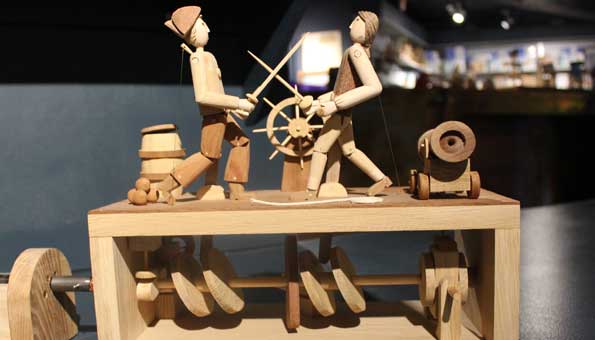
Dug North creates contemporary automata — sculptures made primarily of wood that employ a hand-cranked mechanism to animate a scene or creature. He makes unique heirloom-quality pieces using fine materials that would have been available a century ago. His work centers around themes that are whimsical, historical, and/or fanciful. North particularly enjoys animating quirky wooden monsters and creating magic-themed automata that perform illusions. He aims to create sculptures that inspire wonderment, bewilderment, or amusement. He is regularly sought out for commissions and grant-based works of kinetic art.
North provides creative services and expert advice on all aspects of automata to a wide range of interested parties. He was recently interviewed as a subject matter expert on the history of automata for The Mechanical Man at the Heart of Hugo, a bonus feature included on the DVD/Blu-ray release of the academy award winning film Hugo.
In addition to founding one of the largest and longest-running blogs on automata, he writes extensively on the subject for other outlets such as the Cabaret Mechanical Theatre Blog and Applied Kinetic Arts. His work and writing also appear in print for MAKE, Woodcraft, other magazines, and books.
E-mail: http://www.dugnorth.com/contact.aspx
Jelle Bakker
Rolling Ball Artist
I am Jelle Bakker and I live in Amersfoort (the Netherlands). i was born in Wervershoof (near Hoorn, the Netherlands) in 1983 and my biggest hobby is constructing marble machines. Since 2001 I began constructing more complex room sized marble machines with elevators and multiple paths.
My biggest milestone was setting the guiness record longest marble run in the world on 21st May 2009. This marble run was 210.31 meters long. Unfortunately, it’s already broken by someone else in September 2011.
The Marble Machine “Marble MADhouse” is my first international project outside of the Netherlands and Belgium. This marble Machine has 3 marble lifters and lots of paths with bells, chimes and woodblocks. Now i hoping of a international project outside of europe.
My biggest dream is having a big hall with a giant marble run with thousands of track meters with light shows and multiple paths and lifters.
E-mail: info@knikkerbaan.nl
Website: http://www.marblerun.org
Ulrich Westerfrölke
Kinetic Artist
Born 1956 in Düsseldorf, Ulrich then moved to Aachen to study Physics. Following this he returned to Düsseldorf in 1980 to study at the State Art Academy.
The key sentence in physics “forces are evident in their actions” and questions concerning borderline material creations are relevant to his artistic work.
Westerfrölke’s works are about function. They are in part driven by simple mechanics, cranks and thrust mechanisms, waterwheels or windmills. He uses mechanically functioning structures incorporated in filigreed, geometrical metal frames to activate space and to give rhythm to the viewer’s observations. This fascination with mechanics, his attention to detail and perfect craftsmanship underline these intentions.
In designing his creations, he savours the ‘spaces in between’, ‘stolen time’ and the ‘unproductive moments’ of daily life. This is the time when images appear when doodling while on the phone, letting the mind wander while driving, playing music or day dreaming.
The fragile wire objects Ulrich creates are conceived for interior spaces but more recently he increasingly now works in conjunction with planners and engineers to create works for public spaces.
E-mail: uli.westerfroelke@t-online.de
Tim Donald
Automata Artist
Tim Donald was born, raised and still lives along the beautiful countryside of the Welsh Marches where one of his earliest memories was being amazed by a whirligig in his Grandparents garden and the fascination of how it worked.
After studying at art college, followed by some years working as an undertaker, Tim finally turned his love of making things, (and then trying to successfully get them to move), into a full-time way of life.
The inspiration behind the characters and subjects of his work spans a wide spectrum, the colours and themes have grown from influences as diverse as the ancient landscape in which he lives, to folk art, settlers and folklore.
Tim lives a hectic life with his wife and children, and currently has three dogs, two cats and a tortoise.
All of Tim’s work is hand-carved, and hand painted and finished.
E-mail: tdonaldautomata@btinternet.com
Alan Parekh
Kinetic Artist
Alan Parekh is an electronic professional who has worked in many fields installing and developing electronic solutions to complex problems. His interests are also focused on software engineering and embedded systems development.
More of his electronic hobby projects and interests can be found on his personal website. Alan holds a Bachelor of Computer Science Degree and is a member of the Certified Technicians and Technologists Association of Manitoba.
Contact Alan
Alex Allmont
Kinetic Artist
Alex was awarded a distinction in MA Contemporary Art and Music at Oxford Brookes University and is now continuing with an MPhil/PhD to extend his exploration of rhythmic effects.
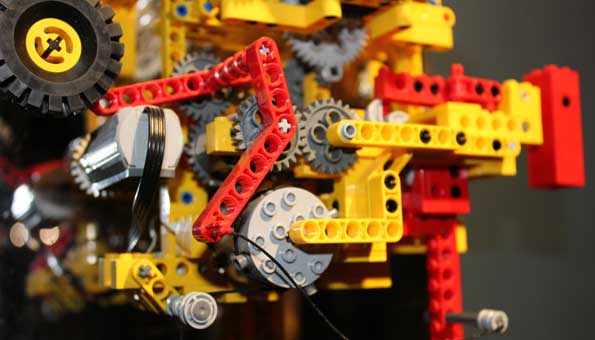
He is also a full-time software engineer at NaturalMotion Ltd, Oxford, where animation software is developed for the film and games industry. His practice includes sculptural, sonic, performance and multimedia work, but LEGO is his material of choice for playfully sketching ideas and developing pieces.
The perceptual effects experienced in rhythm, polyrhythm and phasing is the driving fascination in his work, and this comes from a deeper desire to understand emergent properties of complex dynamic systems. He uses playful ways to capture an audience, slow their attention, and allow them to explore this complexity in their own way.
Contact Alex
Andras Mengyan
Kinetic Artist
Andras was born in 1945 and is from Békéscsaba, Hungary. He attended the Academy of Applied Arts in Budapest and has an MS degree.
His work has been exhibited all over the world and he has pieces in many museums in Europe.
In his current work, Mengyán attempts to find the answers to three questions:
• How is it possible (if it is possible at all) to comprehend simultaneously, the multifaceted nature and qualitative changes and aspects of a perceived environment?
• Is there any means of visually expressing this simultaneous perception?
• Is our three dimensional awareness adequate to comprehend all of these?
In weighing up the possibilities to find an answer he found a solution, which in short he refers to as: Polyphonic Visual Space or Simultaneous Spatial View.
Contact Andras
Canace
Steampunk Artist
Canace Jewellery is displayed across the globe and the artist has participated in several group exhibitions. Her work has been featured in numerous galleries and the best part of her life, is seeing her artwork come to fruition.
Since she was a child Canace was fascinated with old things, tarnished things, rusty things, things with a history. Canace has collected everything from rusty springs to dragonfly wings. Her greatest joy is to create something with the treasures she collects, to give them a new life and interpretation.
Canace jewellery is not to the taste of everyone, but if you can grasp the feeling and creativity that goes into a piece then the artist has succeeded.
Contact Canace
Clive McCarthy
Senior Lecturer- Lincoln University
Clive McCarthy is a senior lecturer in Digital Image and Design at Lincoln University. He has always been fascinated by the working of light, technology and the interpretation of it.
In showing some of his students work at the Kinetica Art Fair in 2012, he allowed The MAD Museum to showcase one of the pieces he had been working on.
Contact Clive
Contemporary Heaven
Contemporary Heaven is a retailer and manufacturer of quality contemporary home accessories with many products being exclusive to the company. Contemporary Heaven’s aim is to offer customers the opportunity to buy unique, stylish, design led modern products direct from the manufacturer.
The company ensures that the product range represents quality and value for money, backed up by efficient customer service. The clock at the MAD Museum is designed by Wil Van Den Dos and is made by Invotis.
Contact Contemporary Heaven
David Rosewell
Kinetic Artist
David currently lives in London and was born in Welwyn Garden City in 1981, after graduating from Sir Frederic Osborn School, he studied GNVQ Art & Design at Oaklands College. After College, he studied Fine Art at Middlesex University where he specialised in Kinetic Sculpture and was heavily influenced by Jean Tinguely and Rebecca Horn.
David is inspired both by his fascination with mechanics and kinetic art. His areas of expertise cover kinetic sculpture, painting and metal work. His work is created from found objects, wood, canvas, meccano, motors and various other mechanical components.
David’s work highlights some of the political and moral contrasts (such as greed, corruption and manipulation) which society faces both as individuals and as a whole. The movement bring these issues to the fore and helps give his work extra depth.
Contact David
David Williams
Kinetic Artist
David Williams has pursued his life-long interest of Kinetic Art for many years and has created many amazing contraptions using precise and intricate workings and mechanics.
A lecturer in 3D design for many years and more recently in props and special effects he uses his appreciation of both art and science and the relationship between organic and inorganic materials to produce stunning exhibits.
His work usually involves copper, brass, leather and organic compounds with geometric accuracy and an engineered flair which exudes his mastery in each component of construction and placement.
In his own words David says, “Each statement involves a system only pertinent and definitive to itself. It will always be an intuitive adventure”.
Contact David
FANUC Robotics
Robotics Manufacturer
FANUC Robotics UK is part of a worldwide corporation which offers to the manufacturing industry intelligent automated robot machines. The robots are typically used for cutting, lasers and injection moulding.
However part of the research and development team also create items which can be used for other applications such as picking up items and sorting them in specific places.
Locally based in Coventry, the team at FANUC has donated one such robot to The MAD Museum and we are very proud to be able to showcase the company’s engineering prowess
Contact FANUC
Jim Bond
Kinetic Artist
Jim Bond is a British sculptor specialising in dynamic interactive installations and kinetic sculptures which use motors, electronics, sensors and computers to engage with the viewer.
Working as an artist since 1980, he has exhibited in numerous group exhibitions at galleries including Flowers East, and more recently The Saatchi gallery and Kinetica Art Fair. He also is a visiting lecturer at Nottingham University.
Jim uses metal to represent living things, the inanimate versus the animate.
Jim has many static sculptures but also creates Kinetic Art incorporating his talent for design as well as movement.
Contact Jim
Marcel Betrisey
Kinetic Artist
Marcel Betrisey has followed his dreams and allowed his creativity to give his life direction since he was young. Having travelled the world he set up a business for electronic repairs. This enabled him to start exploring his artistic abilities and little by little he started to divert objects from their original purpose, for fun and above all to get his revenge on our throw-away culture.
The other motivation for the “diverted objects” was the lack of tools: as he was not always able to manufacture his parts he would pick from his stock of old spares.
His clocks and art pieces fall into two categories: those that Marcel builds from scratch and those made from salvaged parts.
The easiest ones are those where he designs everything because he just needs to have an idea and turn it into reality.
In his own words Marcel’s has a firm rule for life: “I don’t follow anybody else’s footsteps and don’t go back on my own. That’s what I like most in these pieces; they are beyond words and fashions.”
Contact Marcel
Meinhardt Bohnenberger
The Swabian company Meinhardt-Bohnenberger, was founded in 2007. It is characterized by innovation, supreme quality and high reliability.
Magical effects and “legerdemains” have always cultivated a huge fascination for people of all ages. They appear stunning and encourage the spectator to brain storm and question what they see. The exclusive magical displays of Meinhardt Bohnenberger use this effect, to stage something in order to obtain its full attention.
Andreas Meinhardt is master of goldsmith and public certified creator of shapes for jewellery and appliances with award. His development and creation of novel magical requisites for illusionists are demanded world-wide, as well as his skills as a consultant for magical tricks and special effects in film and theatre.
Dr. Gernot Bohnenberger develops magical marketing concepts for companies, works as a consultant and manager of Business and cultural events and is author for several magazines. He attained the title “World champion of magic” (1997 – 2000) awarded by the Fédération Internationale de la Societé des Magiciens (FISM).
Contact Meinhardt-Bohnenberger
Michael Croft
Automata Artist
Discovering contemporary automata on a trip to the U.K. in 1988, Michael was fascinated by the combination of mechanics and whimsy. He started collecting about 1995 and used the models to introduce the rudiments of kinetics to my 3-Dimensional Design classes at the University of Arizona.
The students were immediately engaged and he began to play with the idea of making his own works. The idea for his first piece, ‘The Flasher’, sprang to mind fully-formed and was completed in the spring of 2001.
He says: ‘Creating Automata has been a nice departure from my 40 year career as a jeweller, metal smith and educator.’
Contact Michael
Neil Hardy
Automata Artist
Neil was originally trained and worked as an architect for 13 years before seeing that Automata was a far more interesting line of work. 2012 will the twentieth year he has been creating models and it still excites him every time a new piece of work is finished.
He became a member of the British Toymakers Guild in 1993. Since that time, Neil has engaged a number of craft shops and galleries who have sold his work on a regular basis throughout the UK.
As Neil’s work has become more renowned, he receives many letters from abroad enquiring about his pieces. Many items have been sold in a number of galleries from Paris to Japan and Australia to America!
Contact Neil
Nik Ramage
Kinetic Artist
The machines Nik Ramage creates forego utilitarian functionality in favour of futility, uncertainty and fragility.
These contraptions are assembled from components that were designed for another purpose, often utilizing elements that are slightly damaged or completely run down. Some of the machines work relentlessly at their task like an almost useful tool, while others have more hesitant actions and seem to struggle under their own load.
This is technology from the shadows, absurd, paradoxical and at times completely comical.
Contact Nik
Origami Boe
Transmedia Artist
Origami Boe is a transmedia artist from Norway. Having worked mainly in the fields of microsound, electro-acoustic, ambient, improvisation and extreme noise music he has also established a network of artists called the Origami Republika. As a result, Boe has travelled and toured extensively performing music and holding workshops.
Boe’s speciality is the acoustic laptop which enables people to create music, sounds and works of art using tiny sound objects which are then amplified. He has also worked in performance, visual art, street art, mail art and writing.
Contact Origami Boe
Piotr Jedrzejewski
Kinetic Artist
Kinetic objects, such as clocks, animals, and fantastic creatures, appear in the mind and dreams of Piotr Jedrzejewski. Initially they occur as just an outline of a form, a notion, an idea without details.
Often they are experienced as only a mood, emotion, or feeling. Jedrzejewski waits to take a pencil in his hand, letting ideas crystallise and mature in his head before committing himself to a drawing.
Since Jedrzejewski was a little boy he had always loved creating machines that were fulfilling absurd functions. His workshop is full of tools and he uses screws, nails, pins, and cogs. A few years ago he would make every element by hand. This was great fun for Jedrzejewski but limited the size and complexity of his creations. He then started to use more modern technologies, but still stays close to the soul of his works.
Contact Piotr
Richard Simmons
Founder of The MAD Museum and budding artist!
As founder of The MAD Museum, Richard has donated pieces of kinetic art to display which he has collected over the years.
Not only that but he also has created his own contribution out in the garden, the Water Feature and intends to build more exhibits himself.
Richard has always been fascinated with mechanics, design and art and how each very different aspect blends together to create a visually impressive display. Originally a trained chartered surveyor, turned property developer, he then moved towards the internet and set up information related websites for the construction, renewable energy and luxury markets.
For a long time he has been searching for the right location to bring The MAD Museum to fruition and its launch has only encouraged him to find more works of art for the world to see.
Sam Wade
Kinetic Artist
Sam Wade worked as a civil engineer in England before developing an interest in sculpture when his career took him to Scotland more than 30 years ago. He now lives in the beautiful Scottish Borders and exhibits widely throughout the UK.
He likes to think his kinetic sculptures tread a fine line between art and engineering, exploring the long tradition of form-through-motion by combining movement and machinery with a degree of precision, humour and truth to materials.
He works mainly in stainless steel, aluminium, brass, copper, Perspex and wood to construct a sculpture rather than carve or cast it.
He is currently Vice President of Visual Arts Scotland VAS, and a professional member of the Society of Scottish Artists, SSA.
Contact Sam
Stephen Jendro
Rolling Ball Artist
Stephen has been building kinetic, track based gizmos almost his entire life.
About 10 years ago he started building Rolling Ball Sculptures by TIG welding stainless steel.
His sculptures value composition and geometric proportion along with a madcap sense of wonderment and mesmerisation.
For Stephen a lot goes into each piece, just a few skills on his list include: art design, kinetic art, architecture, metallurgy, blacksmithing, industrial safety, welding, electrical design, physics, mechanical engineering and storytelling!
If you have any questions at all about Rolling Ball Sculptures, you can email Stephen at sjendro@gmail.com.
Website
Stuart Dunbar
Kinetic Artist
With a BA (hons) Degree, in Technical Arts and special Effects from Wimbledon College of Arts UAL, 2008 Stuart has continued his dedication to Kinetic Art and Automata.
The central themes running through his work are free will and randomness and then creating various machines and objects to whimsically test out these futile quests.
The act of viewing the work is also a central element to understanding it. Asking the viewer to play with the piece to unlock its stationary position in order to unveil a reactive presence is of central importance to the artwork.
The objects themselves are often created with traditional craft based practices combined with contemporary technologies and software.
The result is handmade objects with the intelligence to communicate.
Website
Wanda Sowry
Automata Artist
Wanda designs and makes wooden Automata. She makes a mix of commissioned pieces for big birthdays and anniversaries and pieces for various galleries and exhibitions in the UK.
The mechanisms are kept quite simple, and no paint or varnish is used on the wood. Wanda prefers to use different natural colours of wood instead.
All the wood used is either reclaimed or small off cuts. Working very much by hand Wanda also shapes her pieces using an old mini belt sander with a small inch wide belt.
Other tools she uses are a small bandsaw, scroll saw, pillar drill and a dremel.
Website
Alan Westby
Automata Artist
Most people’s career paths tend to be a series of “zigs and zags” as opposed to a straight line and Alan Westby’s is no different. From early training as a sculptor, to designing exhibits for children’s museums to running a major aviation museum, Alan has always looked to new challenges.
As with many artists, Alan has always been fascinated by what makes things work. “Automata are a natural fit for me. I love the challenge of animating a whimsical scene, trying to figure out what mechanically has to go on below the deck to make everything go!”
Alan’s current work reflects an interest he has with early science fiction, specifically the robot and rocket imagery. While frightening when it was originally made, today it is viewed as nostalgic and humorous. “These automata are fun reflections of life, and how our perceptions change over time.”
Website
Jean Pierre Galopin
Automata Artist
Jean Pierre Galopin was born in 1956 in Brittany, France. Since he was young, Jean Pierre has been captivated by putting different elements together, computer engineering, electronics and construction sets.
His highly amusing beautifully crafted pieces of art are conceived in his workshop. This hideaway is chock-a-block full of bits of machinery, electronic parts, wood and metal workings, computers, cables of all colours and stacks of books going right up to the ceiling. “It is a bit disorganized and chaotic but it is my paradise. Here I give life to my ideas” said Jean Pierre Galopin.
Jean is the co-author of a World Patent for washing machines and his creations have been referenced by well known and respected automata artists such the famous American inventor Dug North and Mechanical Lizard.
“I want to write poetry in 3D, I find it funny!”
Website
Wayne Dinsdale
Sci-fi, fantasy art sculptor
Wayne was born in Stoke-on-Trent, England in 1949 just a few miles from the internationally famed `Wedgwood and Doultons ` Pottery factories.
After considerable travelling both in the UK and abroad (Father being in the Armed Forces) Wayne eventually settled in Leamington Spa. Here he attended Aylesford High School until the age of 15. Upon leaving school he worked at Leamington Sawmills as a trainee wood machinist.
At 17 Wayne left Leamington Spa and joined the Consolidated Pneumatic Tool Company and started a comprehensive training program in Pneumatics and Hydraulics at the company’s factories in Fraser burgh, Aberdeen and Glasgow. On completion of the training program Wayne went on to do Hard Rock Tunnelling, Mining, and Quarrying as a Demonstration Driller on an International basis. He then transferred to the Industrial Division and became very involved in Tube and Pipe Tooling targeted at the Petrochemical and Power Generation Industries.
By the age of 32 he was running his own successful engineering company and had international patents and sales on his own self designed Tube and Pipe Weld Preparation machines. Wayne went on to design a host of specialised Pipe Tooling some of which that were commissioned by Rolls Royce Submarines in the manufacture of Nuclear Reactors.
2004 saw a devastating blow in Wayne`s life when his wife Karen was diagnosed with terminal cancer. It was during this period that the sculpture of The Pneumanoids began as a distraction for them both. Karen a talented published author, would write SciFi Fantasy about the Pneumanoids, whilst Wayne would sculpt. There objective being to be together and escape the reality of the situation. Karen died in the October 2004.
Wayne now lives in Warwick, continues to pursue the sculpting of the Pneumanoids with Steampunk Androids on the drawing board.
Website
Jim Gage
Kinetic Artist
Jim Gage was schooled as a musician but always had a love for creativity and an insatiable appetite for knowledge. As a child, Lego, chemistry sets and soldering irons littered his bedroom, his very own “mad scientist’s” laboratory. After moving away from music he directed his passions towards industrial robots, pneumatic systems, pumps, adhesives, electronics, kites, theatre and more, all of which that is combined into the subject known as kinetic art. Jim loves bringing the magic of machines from the past back to the present and thoroughly enjoys bringing delight to those who take pleasure in his work.
Email
Helmut Baur
Kinetic Artist
Helmut Baur was born in 1939 and is from Meerbusch, Germany. After completing a Toolmakers apprenticeship and studying Electrical Engineering, he embarked on his lifelong ambition of becoming a freelance artist. Helmut uses his passion and skill to create beautiful steel sculptures and pieces of kinetic art.
Helmut specialises in pieces of art that primarily draw messages in a flat bowl of sand. His sculptures absorb energy directly from solar radiation; this process triggers the rest of the exhibit to move and the messages to be written. As well as being stylishly striking and eye catching, Helmut’s art is also conversationally stimulating and has gentle relaxing qualities.
A number of Helmut’s sand sculptures can be found in various hotel lobbies, reception areas, conference spaces and waiting rooms around the world. Today, Helmut Baur continues to practice his art, creating new moving exhibits.
Website